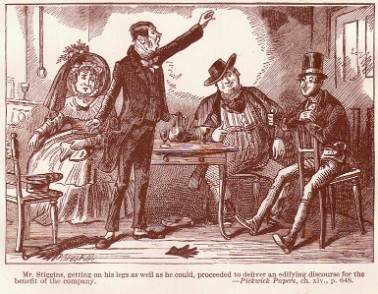
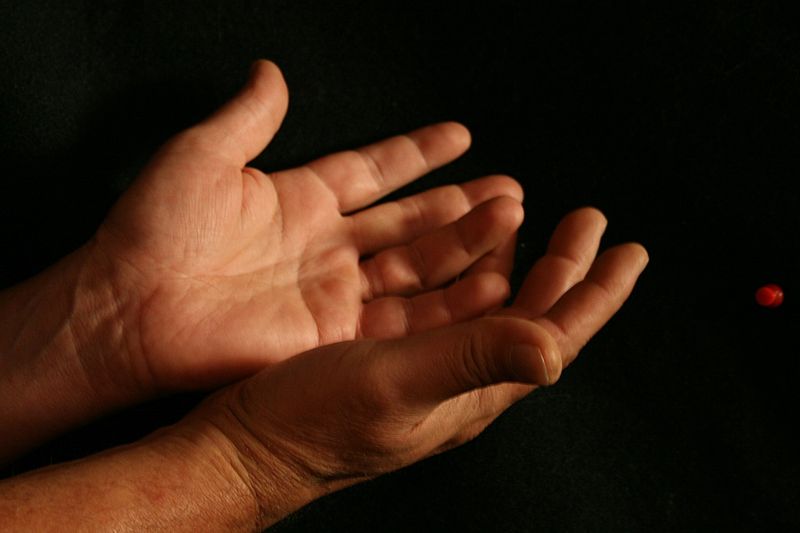
Classical rhetoricians—including greats like Aristotle, Cicero, and Quintilian—acknowledged the importance of oratorical technique in the persuasiveness of the oratory, and they each provided orators with specific instructions on how to use their bodies to enhance the power of their delivery. As an educator of rhetoric, Quintilian discusses gesture’s role at length—over one hundred times in The Institutio Oratoria alone. In Book XI he distinguished the different types of gesture available to a speaker and specifies which are most appropriate. He makes an important distinction,[1] however, between gesture connected to thought and gesture used to punctuate words by arguing that “gesture should be adapted rather to his [the orator’s] thought than to his actual words” (XI, III.p. 89). In this way, gesture becomes a method by which to communicate a meaning connected yet separate from speech. Here, gesture reveals the thought behind the word or the image accompanying the word, and does not communicate the word itself. Although Quintilian goes on to codify gesture, limiting its meaning making possibilities as a non-discursive text, the distinction he makes between gesture of thought and gesture of words is an important one when considering gesture’s function as a modality.
Mode, as approached by Gunther Kress (2010) in Multimodality: A Social Semiotic Approach to Contemporary Communication, is socially and culturally shaped and creates meaning outside of the restraints of language. For Quintilian, gesture as mode allowed the rhetor to emphasize and deepen the spoken word, giving the rhetor the ability to communicate a related, though separate, thought or feeling outside the limitations of language. Gesture held meaning for Quintilian, but he still considered gesture an attribute of language. Kress, on the other hand, argues that “mode offers meaning-laden means for making the meanings that we wish or need to make material and tangible—‘realizing’, ‘materializing’ meanings” (p. 114). Mode provides a way for conceptual meaning that needs substance to be made tangible. He explains that mode helps “make meanings material … according to the intentions of rhetor and designer” (p. 114); therefore, meanings are ultimately determined by how the mode is framed. He names gesture as being one such mode; however, he groups it with modes—such as writing, layout, music, speech, soundtrack, etc—that are not created within the body and by the body. Whereas his grouping of gesture shows how all modes function as a semiotic resource, I argue that gesture stands apart because, though all modes make meaning material, gesture links non-discursive meaning to the bodyliness of humans, physicalizing the abstract concept of mode. Gesture, as mode, gives multimodal instructors an easily identifiable connection between a student’s knowledge of the body’s capacity for expressiveness and the recondite meaning of mode.
Using philosopher Susan Langer’s (1957) theory of symbolization, in his Non-Discursive Rhetoric: Image and Affect in Multimodal Composition, Joddy Murray (2009) develops a theory of language that encompasses both the discursive and non-discursive. He argues that humans are innately programmed to communicate or to express meaning about what they experience through their senses, and the way they do this is through both discursive and non-discursive “language” or “symbolization.” Within this theory of meaning-making and meaning-communicating, Murray defines the term “symbolization” as “the very nature of a human symbol-use in all forms[;] …. the act of cognizance at the very beginning of our lives that is hard wired, innate, inevitable, and most characteristic of our species” (p. 13). This theory of language, however, not only challenges how human’s express and communicate meaning, but it reorients how we conceive the production of thought. If symbolization—and not text based language—defines human symbol-use, then human’s do not think using only words; instead, thought is formed using both discursive and non-discursive symbols or images. Since humans make meaning not just through words, it stands to reason that thought production is not limited to words, making the connection between thought and non-discursive gesture easier to understand.
Even though we experience the world through all of our senses, scholars typically privilege discursive symbolization over the non-discursive. In our current multiple media laden society and with a growing necessity to teach multimodal compositions to students, favoring text over non-traditional texts is not only impractical but increasingly detrimental to students who need these skills in the workplace. The non-discursive text, however, often proves challenging to discuss using words. Unlike the linearity of discursive text, the non-discursive is free of ordering and “often happens at once,” and consequently, the non-discursive is often “employed to symbolize what cannot be said or written directly by word” (Murray, p. 4). For instance, multimodal compositions utilize more than just words to express meaning. These compositions incorporate the discursive and the non-discursive to communicate with the viewer, and what text is unable to express, non-discursive text can. Combining words with images and music allows the composer to communicate simultaneously through three separate modes—semantically, aurally, and visually— allowing the viewer to “read” a text comprised of three separate but interconnected modes layered to create one whole meaning. Similarly, gesture is often paired with the spoken word; however, gesture has a greater capacity for meaning-making as non-discursive text.
[1] Kendon points to this same distinction, but he argues that it reveals a difference between gesturing that marks a speech act and gesturing as a vehicle to express emotion (p. 18).